Does Slack affect inflation?

This is an interesting piece in WSJ that poses the question: Does slack affect inflation?

Economists, Mr. Bullard notes, have badly misread the degree and importance of slack in the economy in the past. In the 1970s, the Fed bet that high unemployment meant inflation would fall. Instead, it rose: The productivity of the nation’s work force was slowing, resulting in a need for more workers that created unexpected inflationary pressure.

also see his paper on inflation:

The main conclusion of this paper is that independent central banks will set low positive inflation targets in economies that possess highly developed financial markets. This finding seems to be broadly consistent with the comfort zones articulated by some of the world’s leading central bankers. Less fortunate societies with relatively undeveloped asset markets will choose higher inflation targets to improve credit market performance. Slower growth tends to raise inflation targets, and the highest targets should be expected from stagnating economies with poorly developed financial institutions.

This is also an nice paper by Bullard from 1999, with a nice inflation graph. And

In suggesting a numerical target near 2 percent, Bernanke emphasized that very low levels of inflation
are generally preferred, but not so low that the FOMC would face an unacceptably high risk of encountering the zero lower bound on nominal interest rates, as has occurred in Japan over the past decade.

from here in 2005.

Eine persönliche, jährliche Gesundheitsbilanz

Was ein modernes Gesundheitswesen braucht, ist eine persönliche, jährliche Gesundheitsbilanz, welche jedes Jahr von der Krankenkasse für jedes Kassenmitglied erstellt wird. Also was habe ich einbezahlt, was habe ich ausgegeben von meinem Konto.

Genau wie die Firma, muss der Bürger dann auch Buch führen über seine eigene Gesundheit. Genau gleiche wie die Firma, sollte der Bürger auch eine eigene Risikoanalyse erstellen müssen über sein eigenes Verhalten (Extremsport, Rauchen, ausgeglichenes Essen, Übergewicht, etc).

Die Erfolgsrechnung wäre dann von seinen Ausgaben und Einzahlungen bestimmt. Seine eigenen Investitionen in seine eigenen Gesundheit (z.B. Sport aber nicht Extremsport) würden sich dann in seiner persönlichen Bilanz auswirken. Der Bürger soll also selber dafür sorgen, dass er nicht zu viele schlechte Risiken mit sich rumträgt. Und wenn er es doch tut, dann sollte er es in seiner Risikoanalyse vermerken und sich dessen bewusst sein. Er muss sich bewusst sein, dass seine Investitionen und Ausgaben in seine eigene Gesundheit gesteuert werden können, von ihm selber.

Der jährliche Vergleich der persönlichen Gesundheitsbilanz ermöglicht den wahren, inneren Wert der eigenen Gesundheit zu ermitteln. Zudem wird das Kostenbewusstsein durch das jährliche Erstellen der Bilanz vertieft.

Die Krankenkasse hätte eine beratende Funktion beim erstellen der Bilanz. Verantwortlich für die Bilanz ist nur der Bürger selber. Er muss sie unterschreiben. Die Positionen in der Bilanz, ob es ein Aktiva oder ein Passiva ist, darüber muss der Bürger sich bewusst werden. Somit kann z.B. jeder Arztbesuch entweder zur Geldvermehrung oder Geldverschwendung zugewiesen werden. Ein vorsichtiges Abwägen der Investitionen ist gefragt.

Der reine Konsum von Leistungen führt wie bei der Firma die zuviele schlechte Investitionen tätigt zum Bankrott (Chapter 11).

Who and what is driving Linux?

This is an excellent paper about Linux:

http://www.linuxfoundation.org/publications/whowriteslinux.pdf

from the paper:

Distributors like Red Hat, Novell, and MontaVista have a clear interest in making Linux as capable as it can be. Though these firms compete strongly with each other for customers, they all work together to make the Linux kernel better.

or

Companies which are not in the information technology business can still find working with Linux
beneficial. The 2.6.25 kernel included an implementation of the PF_CAN network protocol which was contributed by Volkswagen. 2.6.30 had a patch from Quantum Controls BV, which makes navigational
devices for yachts. These companies find Linux to be a solid platform upon which to build their products;
they contribute to the kernel to help ensure that Linux continues to meet their needs into the future. No other operating system gives this power to influence future development to its users.

Der Bundesrat verteidigt den Schweizer Rechtsstaat gegen die USA

In einer sauber durchgezogenen Pressekonferenz hat gestern der Bundesrat (Calmy-Rey, Merz, Widmer-Schlumpf) das Schweizer Rechtssystem gegenüber den USA verteidigt und im Zusammenhang mit der UBS und dessen 4450 betroffenen Kunden informiert. Ein Lob an die Damen und den Herr. Die Frage ist jetzt: Welcher Amerikaner wird zuerst vom Bundesverwaltungsgericht Gebrauch machen?

Dass die UBS im Private-Banking in den USA aggressiv neue Kunden angeworben hat und damit auch sehr erfolgreich war (bis der US-Staat eingreifen musste) ist eigentlich ein Lob für die UBS! Sie hat gut gearbeitet. Dass sie diese Gelder dann aber “30 Minuten später” wieder in den US Immobilien-Markt investierst hat, das war wohl mit ein bisschen Übereifer behaftet und ein klarer Fehler der damaligen UBS Führung. Das war kein Value-Investing. Das war Momentum-Investing.

Health Care Costs and Universal Care

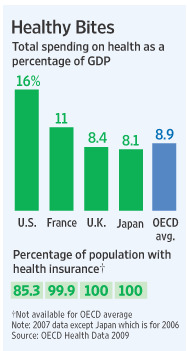
This is a good piece of journalism about universal care and health care costs. Some nice data:

Total spending on Health as a percentage of GDP

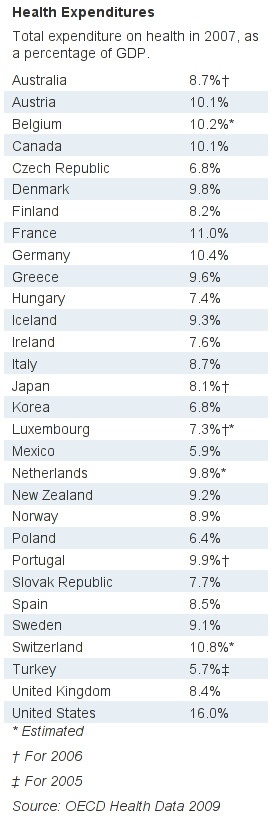
and this

Health Expenditures. Total expenditure on health in 2007, as a percentage of GDP.

Verrechnungssteuer auf dem Ertrag von Gesellschaften

Heute musste ich das Formular 110 ausfüllen für unsere GmbH. Das Formular heisst “Verrechnungssteuer auf dem Ertrag von Gesellschaftsanteilen, Partizipations- und Genussscheinen inländischer GmbHs”.

Dinge die beachtet werden müssen:

1. Wenn den Aktionären eine Dividende ausbezahlt wird, so erhalten die Aktionäre 65% vom Betrag. Die restlichen 35% werden der Eidgenössischen Steuerverwaltung überwiesen. Nach dem man die Dividende auf der eigenen Steuererklärung als Einkommen ausgewiesen hat, erhält man die übrigen 35% von der Steuerverwaltung zurück. Diesen gesamten Betrag muss man dann als Einkommen versteuern. AHV, BVG und UVG müssen dafür nicht bezahlt werden weil es kein Salär ist, sondern eben eine Dividende.

2. Die “gesetzlich erlaubte Limite von 10%” betrifft die Anteilsscheine eines Aktionärs, wenn mehr als 10% des totalen Aktienkapitals an die AG verkauft wurde, weil z.B. ein Aktionär zurücktreten will und z.Z. niemand die Anteilssscheine kaufen will. Dann können die Aktien von der AG selber gekauft werden. Wenn 10% überschritten werden muss man die Checkbox mit “Ja” ausfüllen.

3. Ab 2009 muss das Formular 110 nicht mehr ausgefüllt werden, wenn die Bilanzsumme weniger als 5 Mio beträgt. Siehe auch die zugestellten Unterlagen: Information zur Unternehmenssteuerreform II

Put option contracts

I am trying to understand put option contracts. Some useful links

http://en.wikipedia.org/wiki/Put_option

http://www.cnbc.com/id/30808188

http://www.sec.gov/Archives/edgar/data/1067983/000119312509105560/d10q.htm

From the last link comes this:

Berkshire has written equity index put option contracts on four major equity indexes including three indexes outside of the United States. These contracts are European style options and will be settled on the contract expiration dates, which occur between September 2019 and January 2028. Future payments, if any, under these contracts will be required if the underlying index value is below the strike price at the contract expiration dates. Premiums on these contracts were received in full at the contract inception dates and therefore Berkshire has no counterparty credit risk. At March 31, 2009, the aggregate intrinsic value (the undiscounted liability assuming the contracts are settled on their future expiration dates based on the March 31, 2009 index values) was $13.3 billion. However, these contracts may not be terminated or fully settled before the expiration dates and therefore the ultimate amount of cash basis gains or losses on these contracts will not be known for many years.

Credit default contracts include various high yield indexes, state/municipal debt issuers and individual corporation issuers. These contracts cover the loss in value of specified debt obligations of the issuers arising from default events, which are usually for non-payment or bankruptcy. Loss amounts are subject to contract limits.

High yield indexes are comprised of specified North American corporate issuers (usually 100 in number) whose obligations are rated below investment grade. The weighted average contract duration at March 31, 2009 was approximately 2 years. State and municipality contracts are comprised of over 500 reference obligations issuers, which had a weighted average duration at March 31, 2009 of approximately 12 years. Risks related to approximately 50% of the municipality notional amount cannot be settled before the maturity dates of the underlying obligations, which range from 2019 to 2054.

Premiums on the high yield index and state/municipality contracts were received in full at the inception dates of the contracts and, as a result, Berkshire has no counterparty credit risk. Berkshire’s payment obligations under certain of these contracts are on a first loss basis. Several other contracts are subject to aggregate loss deductibles that must be satisfied before Berkshire has any payment obligations.

Credit default contracts written on individual corporate issuers in North America primarily relate to investment grade obligations. Installment premiums are due from counterparties over the terms of the contracts. In most instances, premiums are due from counterparties on a quarterly basis. Most individual issuer contracts expire in 2013.

With limited exception, Berkshire’s equity index put option and credit default contracts contain no collateral posting requirements with respect to changes in either the fair value or intrinsic value of the contracts and/or a downgrade of Berkshire’s credit rating. Under certain conditions, a few contracts require that Berkshire post collateral. As of March 31, 2009, Berkshire’s collateral posting requirement under such contracts was approximately $1 billion.

US economy declined less in 2nd Quarter 2009

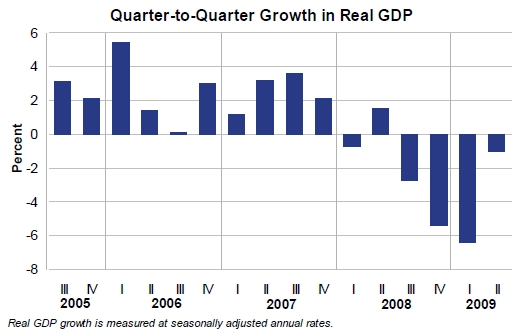
The US economy declined less in the second quarter. This is a very nice grafic.

quarter-to-quarter-growth-in-real-GDP-2005-2009_Q2

Real gross domestic product (GDP) declined 1.0 percent in the second quarter of 2009 after declining 6.4 percent in the first quarter, according to estimates released today by the Bureau of Economic Analysis. Details.