Ok, I had to do it and the result is nice. Chromium (the Google Browser) on my Gentoo Linux Box runs very nice. This is how you get there if you are on Gentoo-Linux:
Ok, because of this post I had to try a Intel SSD. So I bought this one here. I moved all my data over like this. It all worked well and now I am running on my new SSD. And there is a big difference. So a quote from here is totally true:
If you’re curious, it’s the random write performance that you’re most likely to notice and that’s where a good SSD can really shine; you write 4KB files far more often than you do 2MB files while using your machine.
Also Startup-Time of your computer is crazy fast! I can hardly see my Gentoo-Message while BootUp anymore. If your are on Linux, also consider these options for fstab and booutup: noatime, elevator=noop. But read more of your own in the above mentioned links.
Update: There is a newer, faster and cheaper version out now: X25-M G2
It obviously becomes clear, that the US government will have to force the banks to sell their good loans. This time it seems that the banks will carry the heavy burden, because if they don’t the credit system will stay clogged like an old shrumpy toilet. This NYTimes article has an interesting summary of the situation. From the article:
Under accounting rules, banks must carry securities on their books at market prices. Most financial firms have already marked down these assets to prices that might be low enough to lure buyers.
But banks need not carry ordinary loans at market value. Instead, they are allowed to hold them at their higher values until they are repaid. So, for many commercial banks, selling loans now, at distressed prices, would almost certainly lead to large losses. Such losses might raise questions about how some banks will fare in a so-called stress test that federal regulators are in the process of applying to about 20
lenders.
“I don’t see how they are going to get the banks to sell,” said an executive at a large bank, who asked not to be named, given the delicate nature of the Treasury plan. “There are going to be substantial write-downs taken to get them off the books.”
Federal regulators said privately that, in some cases, they might pressure banks to sell.
They will have to force the banks to do so publicly. If they don’t do it the small lenders will suffer even more and the system will go down even more. Specially the banks who took on government money will be forced to do so.
Oh, and just a nice little comparison of deficits. Hit the image to read the article.
I was reading the Article in Wikipedia about Credit Default Swaps. As always Wikipedia offers great information mostly not biased. This quote I particularly find interesting, from the article:
Credit Default Swaps were invented in 1997 by a team working for JPMorgan Chase[7][8][9]. They were designed to shift the risk of default to a third-party, and were therefore less punitive in terms of regulatory capital.[10]
Credit Default Swaps became largely exempt from regulation by the SEC and the CFTC with the Commodity Futures Modernization Act of 2000 , which was also responsible for the Enron loophole. President Clinton signed the bill into Public Law (106-554) on December 21, 2000.
And this is also an interesting Tidbit. Actually this whole article is very interesting. The Systemic Risk of a CDS is especially big, because it still is a private contract!
The Role of the Federal Reserve in Preserving Financial and Monetary
Stability – Joint Statement by the Department of the Treasury and the Federal
Reserve
regarding “Sytemic Risk” and more. Also note in point two
not to allocate credit to narrowly-defined sectors or classes of borrowers.
If you look at the Media theses days the pay of Bonuses and the level of the base salary is highly discussed. AIG is being criticized for paying bonuses after they received USD 160 billion in TARP funds. If you look at the following graph, I am sure anybody would agree that it does not make any sense. Hit the graph to view the article.
Pay Practices WSJ 17.3.2009
Now at the same time President Obama and Secretary Geithner announce plans to unlock credit for small businesses. These are some interesting sings out there. They should be followed.
This is another nice graphic about the market shrinkage. Hit the graphic to read the article:
A Year After Bear - WSJ 17.3.2009
This is another example of Wall Street at its worst. But is it really Wall Street or is it just Human Nature?
This Sunday morning I read the following article in the NYT. “Has the economy hit bottom yet?” In the article they argue – my personal opinion – three important things:
1. Have the housing prices reached bottom yet in the US. In some states they may have but not in all.
2. Where is the P/E ratio today (around 13) of the publicly traded companies in comparison to the 1980 (below 7) and the 1930 (below 6).
3. How is the average US savings rate doing in comparison to other difficult times? Well today it is at about 3% up sharply but after the second world war it was about 7% (postwar average).
So buying stocks should look attractive soon.
Also: If you read this article you will see that today
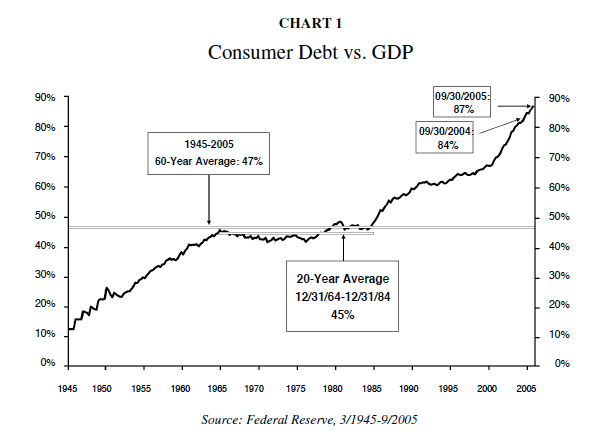
all consumer debt is at 130% of income. Go back to 2000, and it was at 100%; 10 years earlier it was at 80% or 90%.
So this will need time to adjust but it may go faster (less then 10 years) then expected. Click on below image to open another interesting article.
While checking out EDGAR, I finally found the UBS Annual Report of 2007. They are holding a total credit Risk of 1.5 Trillion according to International Financial Reporting Standards (IFRS). See this chart. For an overview of the latest issued stock Options, see this and this. What I find interesting is that the amount of stock Options issued between 2005 and 2007 is massive in comparison to the other years. To me it resembles something of a Checkout. Also note that UBS started a share buyback program in 2006 and 2007 witch obviously is not good for the company (according to Warren Buffett) and just drives up the Stock price artificially and makes the option value higher. I can hardly imagine that this was a coincidence. Compare this to Citigroups exposure.
I just installed the newly released DoubleTwist Application on my Mac and I must say it is the first application where I can publish my Youtube-Videos and my Flickr-Fotos from the same interface! Now this is real Music. Apple always tries to lock you in (and since Obama is president that is not fashionable anymore) and is always late with these goodies to being able to publish to other NON-Apple services. You can grab pictures from your iPhoto Library or just from your Fotos-Folder. Same for videos. I am still missing the feature to create a new set in Flickr. But I hope that will be available shortly. Well done so far DVD-John. Now please also get that iPhone working with DoubleTwist. Can’t wait for the real Sync.


 Open Source Teddy Bears
You must be logged in to post a comment.