
Endlich, der Bär ist wieder im Münstertal! Hoffentlich sind die Schweizer schlauer als die Deutschen und verstehen, dass der Bär im Münstertal auch sehr viele Touristen mit sich bringt. Ev. könnte man sogar eine Bärenzucht starten im Münstertal ;).
GPLv2 vs GPLv3, an open Discussion
Linus says it all in his posts today. See here as an example. It is interesting to see how he argues about GIT, GPLv2 and merging. Linus continues here with his “Tit-for-Tat” argument. An obviously Linus for sure it not confused! Linus also likes the term Open Source more than the term Free Software. And obviously the Future is about “Open Content”. Additional permission in GPLv3 make no sense to Linus. Here there is some more insight (and this one is actually quite inspiring) why Linus chose GPLv2 and why the DNA of Linux is most important, more important then the individual. And now obviously Linus is grumped up. This one is about Dual-Lincensing. Obviously GPLv2v is more free then GPLv3. Linus actually likes Tivo, because they showed good manners in the first place. Why 160-bit SHA1 of a binary should not be made a “derived work” of that software. Linux is obviously and eco-system where the individual only succeeds if everybody succeeds. Last but not least for the day: Idetifying the “correct” binary.
Ruby Garbage Collection Links
- http://letsgetdugg.com/archived/2007/2
- http://rubini.us/pages/3
- Evan Phoenix
- Hongli Lai
- SpaceBabies
- Ruby on Rails Wiki
For us GC in Ruby is not quite doing the job. When the Garbage collection takes too much time we have to restart our application. Usually when the garbage collection takes too much time, Ruby is also using quite some memory (in our case more then 1.7 GB or more). That is the time when we have to restart our application to free up the memory. Let me know if you got any ideas.
Was macht InfoCodex mit den Indexierten Dokumenten?
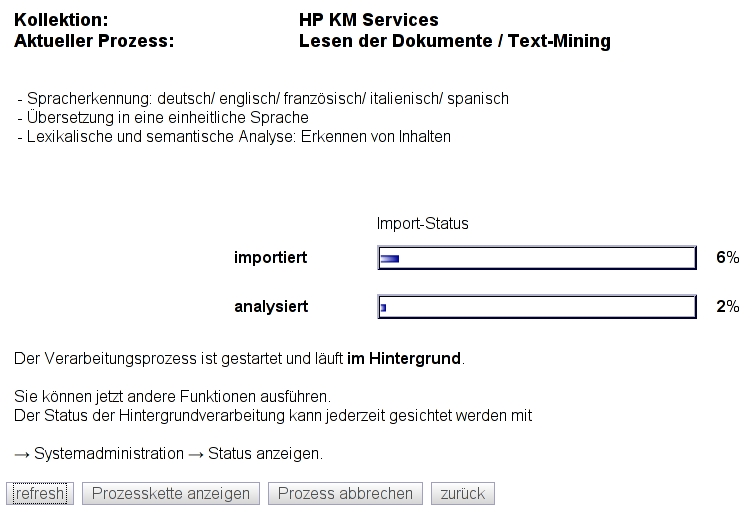
1. Spracherkennung: deutsch/ englisch/ französisch/ italienisch/ spanisch
2. Übersetzung in eine einheitliche Sprache
3. Lexikalische und semantische Analyse: Erkennen von Inhalten
Diese Dinge kann die Konkurrenz nicht. Andere Suchmaschinen und Enterprise Search Softwares müssen zuerst trainiert werden bevor der Inhalt erkennt und analysiert werden kann.
Continuing Discussion from Slashdot.
Mr Kaos has a comment about my comment made earlier on this blog and also here. I have the following to say to Mr Kaos:
1. Well on his Blog Jonathan says “Companies compete, communities simply fracture”. What I do not agree with is that “communities simply” fracture. It sounds disrespecting to communities, like the king sitting on the big throne talking about “hobbyists” as other people say. Companies fracture as well. Companies produce products and some of these products end up having a long life cycle where as other products end up having a very short live cycle. Btw people “fracture” as well. I believe it is in nature to “fracture”. It is a life cycle thing.
2. Communities cooperate but companies have to cooperate more and more as well if they want to prosper in the 21st century. Just because SUN had a great reputation does not mean they will have one in the 21st century. I believe Linux is about a highly sophisticated cooperation model. Modern companies should cooperate more like i.e. the Linux movement does with its professional kernel developers.
3. Well profit is what the stock market wants. That I can understand. But in the long run I believe great companies are about their customers and their satisfied customers. That in return returns the profit. Just doing profit for profits sake is not a long term business model for me.
4. Well yes, I believe Sun and MS will cooperate more in the future if that is what their clients want. I believe software users want more and more collaboration across platforms and software. I believe Sun and Microsoft will share and compete in the future as Gentoo and Ubuntu do. They compete but they still inter operate. The isolationistic approach of one standard for all does not work in a modern democracy, as everybody wants to be as individual as possible. So yes, if the customer profits you will see a collaboration between Sun and MS. Btw MS is trying to get into the Linux business by their own standard of doing business: sining up with Novell, Linspire and a few others. That is the Bill Gates approach ;).
5. I believe great software is about individual leaders, great people and their compassion for software. Linus is a role model and he must be granted that leadership. The more companies like MS and Sun admit that them self the more they will prospers as well. In other words; the sooner SUN gives out their ZFS under GPLv2 the better for SUN! The faster SUN can learn and will prosper because they actively participate in a modern model of software development. SUN can profit heeps from the Linux software development model. I’m sure Blender is great as well but I believe that the Linux Kernel is the better role model.
6. Now this point is highly interesting. Who is looking on whom and who can profit from whom! That is indeed a very good question. I believe SUN can profit a lot more from Linux then Linux from SUN. With “profit” I actually mean learn. Learn and observe how the kernel development process works. Learn how GIT works. Use GIT to develop and improve ZFS. The question – to me – is not if it is in SUN’s interests or not. The question is how fast SUN realizes that it is in SUN’s interest to inter operate with the OSS world. I believe it is the companies who have to look to the Linux kernel development process and not vice versa. Of course both have great people but it is not only about the people but how to get the most from the developers and their creative minds. That is where Linus and the Linux development model excel more/ the most.
7. I do understand that SUN has liabilities to its customers, but: If the court needs to step into a new development process then the court needs to do so. Still I believe it is not about the court, its about the process to develop software in the 21st century. It is about interoperability and customer satisfaction. Linux customers are among the happiest in the world because the kernel model produces great software. Because the process of the Linux kernel model to produce great software works and is a 21st century role model. Linux also has compliance issues (SCO, Microsoft) but they do not build software “in fear of compliance” issues. They build software because they believe in the Kernel. Of course they respect the law and work within the law.
8. All I am trying to say is that Linux works as Software AND as business model. It is not exactly the same but look what happened with Linux. We have Red Hat,SuSE, Caldera, Gentoo, Ubuntu, etc. Some of them are listed on the stock market some art not. We have a huge playing field inter operating and competing at the same time. That is what I mean with “Linux is a 21st century role model”. Yes, chefs have been copying recipes – in fact – nature has been copying itself over and over. That is true for languages. Japanese “copied” Chinese (Kanji) but then extended it to their needs. The OpenSource role model is a great model for Software and for Business, though it my not be identical.
9. You are returning to the fear of “Lawyers” again. I have it like Linus. Lawyers come after the software. Before the lawyers can act, they need a reason (i.e. software, divorce, etc.) to act upon. This is where the importance of the GPLv2 vs GPLv3 discussion steps in. Together with the whole difference between Software and Hardware. Linus is making good statements there as well. See this and this.
10. I will check out that book. Thank you for the hint.
Linus fires off several comments about Tivo and GPLv2 vs GPLv3
GPLv2 vs GPLv3 – Linux and Sun
1. Linus Torvalds says the following about Sun and Linux
My comment, I do not know if it will be allowed through Jonathan’s Blog censors:
This is very interesting. I got some questions:
1. How can you say, that companies and communities do not compete? That is total Bullshit! Communities and Companies compete more then ever these days. The same as Bloggers compete with the old school media. There is a hell of a lot competition going on. Gnome and KDE are another wonderful example of how communities compete against each other. Ubuntu and Gentoo are another wonderful example!
2. The Old Software development and distribution models do not work anymore and Sun will find out, if they want or if they do not want. Sun needs to learn more – lots more – from the OpenSource development model if they want to prosper in the future.
3. As Linus puts it, merely trying to take away the best people from the Linux Kernel will not work. Sun needs to realize that they must organize them selfs more and more like the Kernel development model is organized.
4. OpenSource tactics can and will be implemented in the Future business world as well.
5. Linux is a 21st century role model.
Wieso erkennt Google eigentlich keine ähnlichen Dokumente?
Firmen wie Apple oder Microsoft generieren bei neuen Produkt-Releasen einigen Hype in der Online Welt. Es kann also durchaus vorkommen, dass eine neue Meldung auf hundert unterschiedlichen Seiten erscheinen kann, immer wieder leicht anders interpretiert. Dies geschieht allerdings ohne eine wirkliche Mehr-Information für den Benutzer.
Ein Beispiel: Vor der WWDC von Apple anfangs Juni machte das Gerücht die Runde, dass die Keynote-Speech von Steve Jobs aufgetaucht sei. Ich habe diverse RSS abonniert und konnte dieses Gerücht auf mindestens 10 unterschiedlichen Websites nachlesen. Dies generiert auch sehr sehr viele Links bei Google, alle mit der gleichen Information.
Mit der Ähnlichkeitssuche von IC kann der User die Dokumente mit ähnlichem Inhalt entsprechend gruppieren, erhält eine viel bessere Übersicht und weniger Links von Google. Die Verwirrung des Users ist bedeutend kleiner und der Zeitgewinn für die Informations-Recherche bedeutend grösser.

Dies ist die Heat-Mat einer Such-Kollektion, gruppiert nach thematischem Inhalt. Inhaltlich ähnliche Dokumente werden gruppiert und nahe beieinander dargestellt.
Repetition of Content
What is it about all these social network sites that makes me slightly impatient? Today I found the news of the leaked iPhones manual on at least 10 different sites. Google will index all of these sites and not be able to tell the difference that all of them talk about the same content: The leaked iPhones manual! This is what I call stupid software. It may be good for Google if they have more links on the Internet. But it is definitely not a great user experience to find the same content over and over again. Smart software should be able to recognize similar content of different documents across more then one language (and no, I do not mean translating the document into another language, I mean cross – language – content – recognition). Smart Software should be able to do so across more then one language. Now speaking about Cross-Language-Search, I would like to mention the following:Cross-language Search: What’s it all about?
The term “cross-language search” is used in many different senses:
1. Some search engine providers claim to support multilingual or cross-language search if they can handle and index documents written in different languages. They search for the exact appearance of the entered search terms, e.g. “war” finds English documents referring to military actions and it finds German documents containing “war” in the sense of “was” (i.e. a meaningless glue word).
2. Other search engines (see, e.g., http://www.google.com/intl/en/press/annc/translate_20070523.html) provide a tool for the translation of a query into a selectable other language, and then, the query is submitted with the translated query text. This is certainly a progress and can be useful in some specific situations, e.g. if one is looking for a hairdresser in Paris.
Shortcomings:
– If one is looking for “member of the board” and “SAir Group” (Swissair) and searches for German documents, the translated query “Mitglied des Brettes” und “SAir Gruppe” won’t provide any results. If “member of the board” is replaced by “Aufsichtsrat” some documents are found but they do not correspond to the commonly used terms “Verwaltungsrat” or “Verwaltungsräte” in conjunction with the Sair case.
– For information research and intelligence services the above-mentioned method does not help because it is not able to compare and rank documents written in different languages.
3. A true cross-language search is possible only if the search engine is able to recognize the thematic content, i.e., if the system realizes that the English translation of a French (or a German etc.) document is equivalent to the original document. This advanced technique is implemented in http://www.infocodex.com. It simultaneously finds documents in all supported languages, without the need for a cumbersome (and arbitrary) translation into each other language. Because of the cross-language content recognition and a well-founded similarity measure, the documents can be ordered by their relevance with respect to the query.
Flash Player that works for Firefox on Linux
When will the Mozilla Foundation produce a Flash-Player that works for Firefox an Linux? I am restarting my Firefox more the 10 times a day because my Firefox on Linux just keeps crashing, specially when I open my https://zdavatz.wordpress.com Site with all the embedded Flash-videos. I hope the Mozilla foundation will solve this issue before they keep hyping more about there Microformats-Stuff.
No I do not have any intention to work on IE.
😉
 Open Source Teddy Bears
You must be logged in to post a comment.